BETWEEN WORLDS
I Saw a Ghost When I Was Eight. It Taught Me Everything I Know About Storytelling.
By Eric T. Pham
I was looking for my parents.
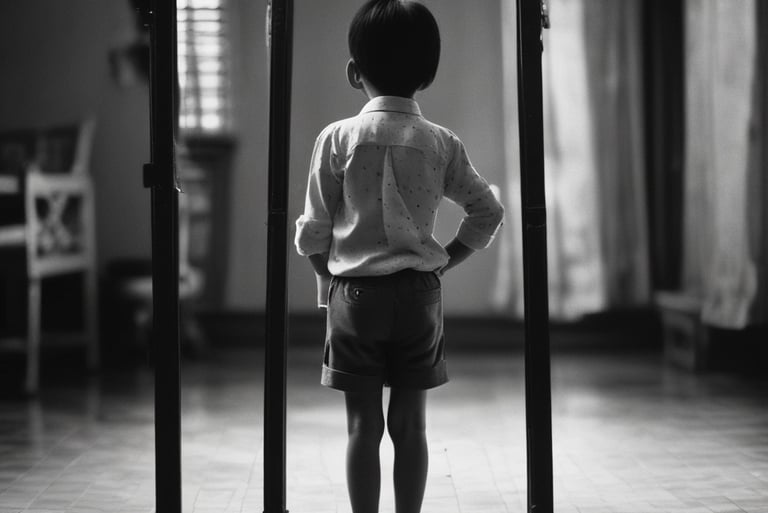
We were living in Saigon, and I wandered into their bedroom the way children do — half asleep, a little afraid of the dark, looking for reassurance. I didn't find my parents. I found something else.
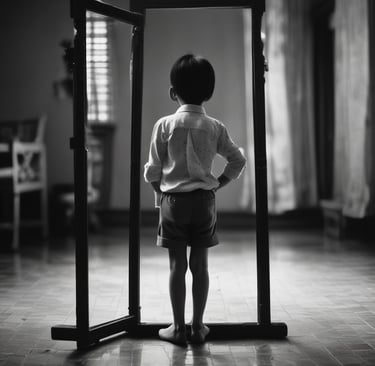
In the mirror on the far wall, I saw a figure standing behind me. A man in white pajamas. Completely still. Where his face should have been — nothing. Just a smooth, blank void where features should have existed.
I froze. My body stopped working. I couldn't turn around. I couldn't run. I stood there staring at this reflection of something that had no face, and the fear was so total and so physical that I lost control of my bladder. I was eight years old and completely undone.
When I finally could move, I ran.
I never saw it again. But I never stopped seeing it either.
For years I carried that image the way you carry something you can't explain to anyone. As a child, you don't have language for it. As a teenager, you learn not to mention it. As an adult, you start to wonder what it means that a mirror showed you something that shouldn't have been there — because in most ghost mythology, mirrors don't lie. They don't reflect what isn't real. They show exactly what stands behind you.
I've thought about that detail for decades.
A faceless figure standing across a room is frightening. A faceless figure reflected back at you in a mirror is something else entirely. It's a confrontation with absence. It asks a question the room itself isn't asking: whose face is missing here?
I was eight years old in Saigon in 1975. Within months, my mother — who served as secretary to the U.S. Ambassador — would receive word that we had to leave immediately or face political persecution after the fall of Saigon. We left without warning. No goodbyes to family, to friends, to the neighborhood I had known as home. We left behind everything except what we could carry, which in my case was almost nothing.
I didn't understand it at the time, but the ghost had arrived just before I lost my face too. Before I became the Vietnamese kid in an American school who didn't speak English, who couldn't explain where he was from in any way that made sense to anyone, who existed between two worlds without fully belonging to either.
Facelessness, it turns out, was the most honest metaphor my eight-year-old life could offer me. I just didn't know it yet.
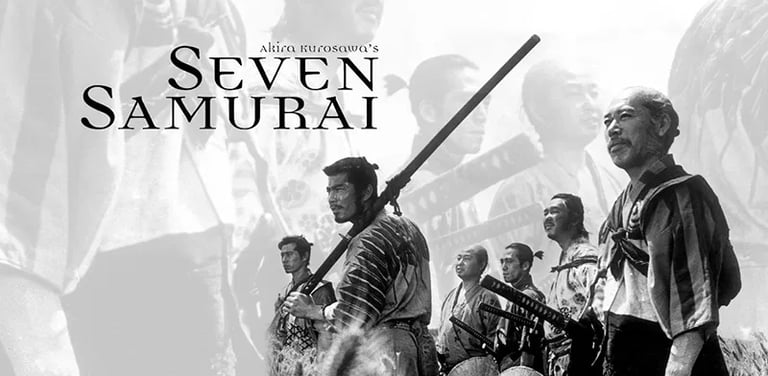
A few years after arriving in America, I saw Akira Kurosawa's Seven Samurai for the first time.
I was young enough that I had to read the subtitles slowly, but old enough to feel what the film was doing underneath the story it was telling. Seven warriors — most of them with nothing left to lose — agree to defend a village of farmers who cannot defend themselves. By the end, four of the seven are dead. The farmers survive. The samurai who remain stand in the rain looking at the graves of their companions, and one of them says something that has stayed with me ever since: "Again we survive. We're the ones who lose."
I didn't fully understand it the first time I watched it. But I understood that I felt something I had never felt watching a film before. Not excitement. Not entertainment. Something closer to recognition — like the film had shown me a truth about sacrifice and impermanence and the cost of protecting something you love that I already knew from my own life but had never seen named so precisely.
That was the moment I knew I wanted to make films.
What I couldn't have articulated then, but can now, is what Kurosawa had actually done. He hadn't made a film about samurai. He had made a film about the universal human experience of giving everything for something larger than yourself and receiving no reward for it except the knowledge that it mattered. The setting was feudal Japan. The truth was everywhere and timeless.
Hollywood understood this. Over the decades, the industry has returned to Seven Samurai again and again — The Magnificent Seven, remade twice, Battle Beyond the Stars, A Bug's Life, countless others across genres and generations. Each version recognized that the original contained something inexhaustible. Each version also confirmed something important: you can recreate the architecture of a great story, cast it beautifully, spend a hundred times the original budget, and still not fully capture what made the first one matter.
Because what made it matter wasn't the setting, the costumes, or the action sequences. It was the emotional truth underneath all of it. The soul of the thing. And that — the soul — is not a production value. It cannot be purchased or replicated. It has to be earned through the depth and honesty of the story itself.
That lesson has guided every creative decision I've made since.
I spent years becoming a filmmaker. Started in fine arts, painting in Brussels for five years before moving to Los Angeles. Found my way into visual effects because it was the most direct path into film — learning the software, mastering compositing, understanding from the inside out how worlds are built digitally. Worked my way through Hollywood: Mission: Impossible 2, The World Is Not Enough, Red Planet, then years at Robert Rodriguez's Troublemaker Studios on Spy Kids, Sin City, Grindhouse.
My first short film — Kat, shot on 35mm Panavision on $1,000 — won a $10,000 Grand Prize at Showtime Network's Alternative Media Festival. I remember opening that letter and reading it twice. That win confirmed something I needed confirmed: I wasn't just learning how to make images. I was learning how to make people feel something they couldn't quite explain. That's the work. That has always been the work.
What nearly three decades in Hollywood taught me, working alongside some of the most technically gifted people in the world, is that the technical brilliance means nothing without story underneath it. Not story as a loose concept — story as a disciplined, rigorous architecture that earns every emotional moment it asks an audience to feel. The VFX, the cinematography, the color, the sound design — all of it is infrastructure. Story is the only load-bearing wall.
Kurosawa knew this. The samurai films didn't move people because of the sword choreography. They moved people because of the human truth inside them, specific enough to feel real and universal enough to cross every cultural boundary the film encountered.
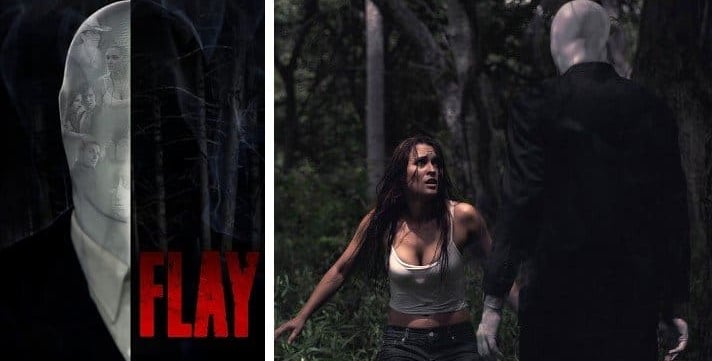
When I conceived Flay, the ghost came back.
I'd been thinking for years about faceless figures across world mythology — the Japanese Noppera-Bō, the Chinese Hundun, Russian folklore, Taino culture, the crowdsourced internet myth of Slenderman. Facelessness appears across cultures and across centuries because it touches something universal about identity and erasure.
But my origin was personal. A bedroom in Saigon. A mirror. A figure in white pajamas.
I layered it with history I'd spent years reading about — Native American children in the early 1900s, forced into assimilation schools, their traditional clothing replaced with suits and dresses, their ceremonies outlawed, their identities systematically stripped. A Shaman whose face was flayed. The horror wasn't the supernatural figure. The horror was what had been done to create him.
As an immigrant who lost a version of himself at eight years old, I understood something about that story that I couldn't have found in research alone. The faceless figure wasn't a monster born of evil. It was a person born of erasure. And erasure, when you've experienced any form of it, is the most frightening thing in the world.
That understanding shaped every creative decision I made developing the film with writer Matthew Daley. The goal was never shock. I wanted to let the audience's imagination do the work — trust them to fill in what the film deliberately left open rather than imprinting every act of violence in graphic detail. The story of siblings and estrangement and what fractures a family — that was the real film. The faceless spirit was the truth running underneath it.
Parents told me afterward that they didn't mind their teenagers watching it. I took that as a compliment. It meant the horror lived inside the story rather than being plastered over it.
But there was a harder lesson waiting.
Because Flay was marketed as a horror film, audiences arrived expecting a particular experience. Jump scares. Gore. The familiar architecture of the genre. What they found instead was a thriller built around family estrangement and historical atrocity, with restraint where they expected spectacle. The mismatch between what the marketing promised and what the film delivered created a gap that no amount of quality could close after the fact.
That wasn't the audience's failure. It was mine.
Marketing is storytelling too. If you don't take ownership of how your film is presented to the world — what expectations you're setting, what emotional experience you're promising — someone else will shape that story for you, and the audience will arrive at the wrong door. A great story poorly framed is still a missed connection.
I think about Kurosawa. Seven Samurai arrived exactly as what it was. There was no gap between what it promised and what it delivered. The audience and the film were in complete alignment from the first frame. That's not an accident. That's craft applied to every dimension of the work, including how it meets its audience.
It's a lesson I won't make the same way twice.
The deeper principle — the one that connects the ghost in the mirror to Kurosawa to everything I've built since — is this:
The most powerful material you will ever have access to as a storyteller is the thing you lived that you can't fully explain. The moment that didn't make sense. The image from childhood that still surfaces when you least expect it. The loss that you've never found adequate words for.
Most filmmakers are trained to look outward for stories. Research a subject. Find a compelling topic. Develop a concept. All of that has value. But the stories that travel — the ones that cross cultural lines and find audiences who have never shared your specific experience — almost always begin somewhere deeply personal and specific. The Vietnamese-American kid who lost his face in a mirror. The Japanese farmers who couldn't protect themselves. The Native American Shaman whose identity was erased in the name of civilization.
Specific. Particular. True.
Seven Samurai works in every language, in every decade, across every cultural reinterpretation Hollywood attempts — not because its story is universal in some abstract sense, but because the human truth inside it is so precisely and honestly rendered that it cannot help but be recognized. Hollywood's remakes don't diminish the original. They confirm it. Every new version is another piece of evidence that the soul of the story is inexhaustible.
That's the standard. That's what a great story actually is.
I think about how many stories like that are still waiting.
I left Vietnam at eight and have spent a lifetime between two worlds — carrying the ghost, learning the craft, building the bridge. Now I'm building something here rather than just returning. Vietnam has more stories worth telling than it has filmmakers currently trained to carry them to the world in a way the world can fully receive. That gap is the work. It's what keeps me going.
The ghost has been waiting a long time.
So has the audience.
Eric T. Pham is a director, writer, and producer. Born in Saigon, Vietnam, he is the founder of Phame Factory Productions and Bridge Builder Entertainment.