Eric T. Pham
The last thing I remember about Vietnam is my aunt's face.
She was, in every way that mattered, a second mother to me. In Vietnamese families the lines between parent and aunt can blur into something deeper than either word captures — she was the one I ran to, the one whose presence meant safety, the one whose voice I still hear when I sit quietly enough.
When Operation Frequent Wind began — the final evacuation of Saigon in the last days of April 1975 — I knew we were leaving, and I knew she wasn't coming. I was a child. I asked her why.
She said: this trip is not for me.
Then she held me and cried. I didn't understand the crying. I thought we were taking a family trip. I felt her sadness without knowing its depth, and something in me registered that this moment was different from other moments — without being able to say why.
I've thought about that exchange for fifty years.
What she gave me — without intending to, without knowing it — was the most direct lesson in storytelling I've ever received. She felt something she couldn't say directly. I felt something I couldn't yet understand. The gap between what was spoken and what was true was where everything that mattered actually lived.
That's what storytelling is. Not the words. The emotion the words are trying to carry. The thing underneath that a child feels before having language for it.
Displacement followed. An American school where I didn't speak the language. Two worlds without fully belonging to either. Then five years in Brussels, where I became a painter before I became a filmmaker — building a visual sensibility in isolation, learning how to see before learning how to shoot.
The name Eric came from Eric Dolphy, the jazz musician who spent his entire career working in the spaces between genres, between notes, between what was expected and what was actually true. I heard something in his approach that matched what I was trying to do and didn't yet have words for. I still use his name as a compass.
Back in the United States, I founded Vietnow in 1995 — the first national English-language Vietnamese-American publication. It's now part of a permanent Smithsonian exhibit. At the time, I just wanted Vietnamese-American stories to have somewhere to exist that wasn't defined by how other people saw us.
The film work came next, and it came fast.
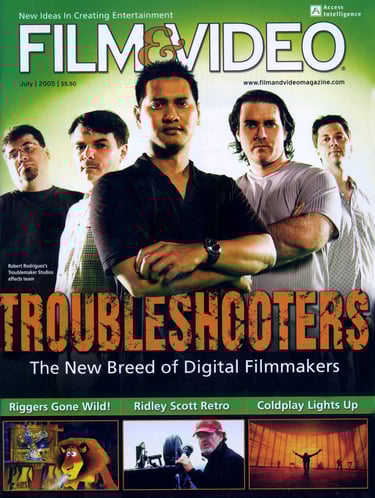
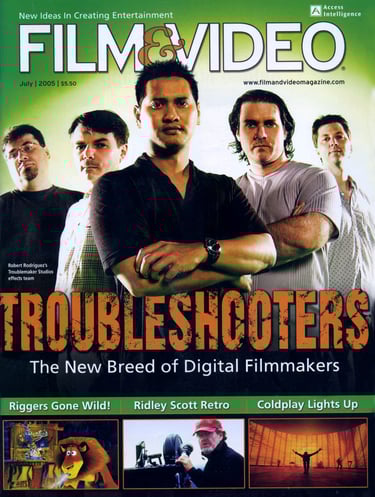
Twenty-seven Hollywood credits over the following years — visual effects supervisor, story consultant, director. Sin City. Mission: Impossible II. The World Is Not Enough. Spy Kids. Grindhouse. All the Pretty Horses. Five years at Robert Rodriguez's Troublemaker Studios working directly with Rodriguez, Quentin Tarantino, and Billy Bob Thornton. The kind of apprenticeship that doesn't have a formal name but shapes everything that comes after.
My short film Kat won the Grand Prize at the Showtime Network Alternative Media Festival in 2001. Tarantino told me personally it influenced a character in Kill Bill. I didn't know what to do with that for about a week.
A Boat Story was a Sundance Writers' Lab finalist. Home, shot in IMAX format, won the Audience Award at the Austin Film Festival in 2024.
In 2006, Kris and I founded Phame Factory. Not because the industry needed another production company, but because we kept losing people we loved and kept asking the same question: what is this work actually for? The answer we kept arriving at was the same one my aunt gave me without meaning to — it's for the thing underneath, the emotion the words are trying to carry, the gap between what is spoken and what is true. Every project since has been an attempt to close that distance.
THE WORK
Director. Writer. Producer. Visual effects supervisor. Story consultant.
Current projects in active development include Spirit Harvest (Vietnamese eco-horror trilogy, partially financed, international co-production), The Sound of Cool (Miles Davis biopic), Willow's Journey (family film, hybrid live-action/CGI/AI production approach), Alien Interview — an adaptation of an international bestseller translated into 14 languages, and Tinder & Flint (animated series).
Distribution and financing partners include Cross Creek Pictures (David Hosler).
Co-founder, Bridge Builder Entertainment — a US-Vietnam co-production company focused on bringing Vietnamese stories to global audiences with the craft to make them travel.
OTHER WORKS THAT MATTER
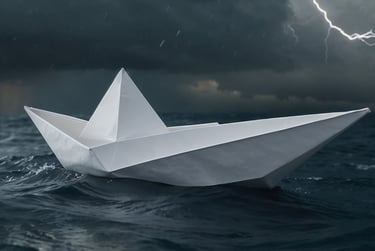
Paper Boats — a novel, forthcoming. Semi-autobiographical. The story that starts with my aunt saying this trip is not for me, told in the form it finally demanded after fifty years of carrying it. Decades of family stories and historical research, trying to honor Vietnamese oral traditions and contemporary literary craft simultaneously. Some stories need a different kind of space than cinema provides.
Fine arts painter. The Brussels years produced work I still consider some of the most honest I've made — abstract, figurative, landscape. Painting teaches you things about seeing that you can't learn any other way, and that you spend the rest of your career applying without always knowing you're doing it.
Jazz listener. The music has been a companion and a teacher since I was young enough to be shaped by it. Eric Dolphy. Miles Davis. The specific courage of working in the space between what is expected and what is actually true.
Innovation without tradition is like a tree without roots. We plant stories that grow into something lasting.
Everything I build is downstream of that conversation with my aunt — the one where she said goodbye without saying goodbye, and I didn't know it yet.