When Everything Can Be Generated, What's Left?
Between Worlds story series
When Everything Can Be Generated, What's Left?
by Eric T. Pham
When I was eight years old, I used to disappear.
Not literally — though given what was happening in Vietnam at the time, disappearing had a certain practical appeal. I mean I would retreat into my imagination with my toys and spend hours in a world nobody else could see. Each toy had its own life, its own personality, its own private drama that continued the moment I put it down and resumed the second I picked it back up. The story never stopped. It just went underground while I was at school or asleep or pretending to pay attention to things that mattered less.
I didn't know what to call this. I just knew it was the realest thing I did all day.
Years later, as an adult, I watched Toy Story for the first time.
I sat there thinking: that's it. That's exactly it. The toys have lives when nobody's watching. The stories continue in private. Everything I was doing at eight years old with plastic figures on a bedroom floor, Pixar had just put on a cinema screen and made $362 million doing it.
I also sat there thinking: I could make this. I have this in me. I just need a studio and about thirty million dollars.
Both of those thoughts turned out to be true and premature in equal measure.
Fast forward to today. The tools that required a major studio, a supercomputer farm, and a $30 million budget to produce Toy Story in 1995 can now be approximated — not perfectly, but meaningfully — for somewhere between $300,000 and a million dollars, depending on what you're willing to do yourself and how creatively you're willing to use what's available.
I know this not as theory but as current production reality. I'm integrating AI into an animation series and a feature right now, generating real budget savings at a level that changes what gets made and what stays on a shelf. The eight-year-old with the toys and the private world is closer than he has ever been to putting that world on screen, and the gap closes a little further every six months.
This is what every previous wave of technological disruption looked like from inside it. When digital cameras arrived, the argument was: anyone can shoot now, everything changes. True. It changed. When smartphones arrived: the barrier is essentially zero, everything changes. Also true. Also changed. Each time, what rose above the flood of new content wasn't better technology. It was better stories.
AI is doing it again — except the scale and the speed make every previous shift look like a warmup act.
But here is where this wave is genuinely different from the ones before it, and where the question gets interesting in ways that have already stopped being hypothetical.
Matthew McConaughey has been collaborating with AI voice company ElevenLabs since 2022. He's now an investor. His voice — the specific drawl, the unhurried cadence, the delivery that made "alright, alright, alright" a cultural artifact — is available for licensed use. Infinite iterations. Decades of content. McConaughey without McConaughey in the room.
Michael Caine, at 92, has joined ElevenLabs' Iconic Voice Marketplace. Companies can request access to his voice for narration, campaigns, creative projects. A voice that carried The Dark Knight, Alfie, Hannah and Her Sisters — seventy years of cinema distilled into a licensable asset, available on demand.
Then it gets stranger. Also on the marketplace: Judy Garland. John Wayne. Maya Angelou. Laurence Olivier. The dead, available for hire alongside the living. Dorothy can narrate your audiobook. The Duke can pitch your product. Maya Angelou can read your brand copy.
Caine's own statement about joining the platform is worth sitting with. He said the technology is "not about replacing voices; it's about amplifying them — opening doors for new storytellers everywhere." A 92-year-old man who has spent a lifetime in stories, choosing to make his voice available forever. That is either the most generous act of artistic legacy imaginable, or the clearest possible illustration of what gets lost when presence becomes a product. Possibly both. I've been sitting with that question since I read it and I don't have a clean answer.
What I do have is a question that follows directly:
If McConaughey's voice is available without McConaughey in the room, and Judy Garland's voice is available without Judy Garland alive — what exactly is the performance? What is the human presence that audiences are responding to? And does it matter, if the story being told is extraordinary?
People watching a film don't audit the mechanism. They follow the story. They feel what they feel. The mechanism disappears the moment it's working correctly. This has always been true and I see no reason why it stops being true when the mechanism is a licensed voice rather than a body in a recording booth.
Which raises the harder question.
What if AI doesn't stop at performance?
What if it masters story itself?
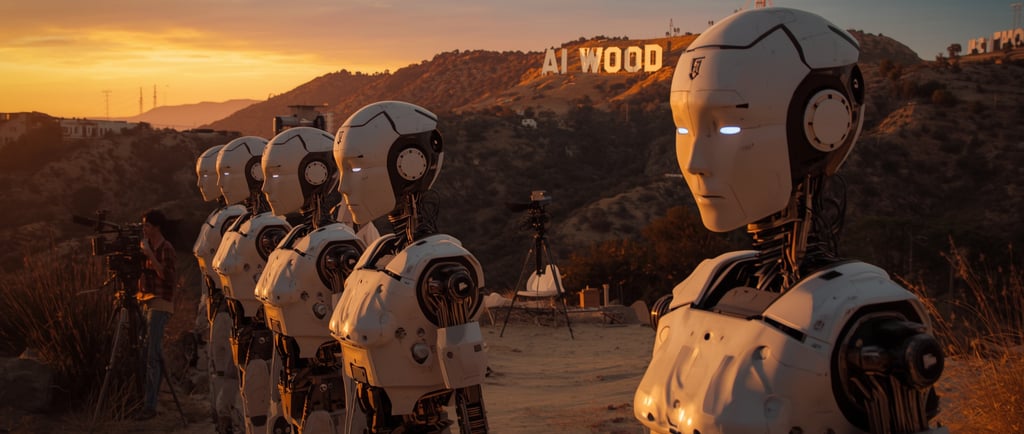
This is the question the optimistic version of the industry conversation tends to skip past because the honest answer is uncomfortable. Generation is already producing structurally competent narratives. The gap between what AI writes and what a skilled human writer produces is currently significant and narrowing. The same trajectory that describes visual effects describes everything else. The tools improve. The gap closes. The timeline is uncertain. The destination is not.
So what's left when the story can also be generated?
Here is my actual position, held with full awareness that I might be wrong — and specifically aware of how I could be wrong: the risk is not that audiences will be deceived. It's that they may eventually stop caring about the distinction entirely.
But I don't think they will. And here's why.
The label.
Not as marketing. As truth. Made by humans — meaning specific, identified human beings with names and histories and the particular weight of lives that shaped every choice they made — will carry a value that has nothing to do with whether the audience can detect the difference. When perfect generation is indistinguishable from human creation, the proof that humans were actually there becomes the scarce thing. And scarce things acquire value.
Vinyl didn't survive the digital revolution because it sounds better by every measurable standard. It survived because people know a record was made by specific hands at a specific moment, that a real musician was present in a real room, that the grooves carry physical evidence of actual human intention. The knowledge of that reality is the product. Not the perception of it.
Toy Story at eight years old was magic because I felt that someone had seen inside my imagination. That someone — a specific group of humans at a specific studio in a specific moment — had cared enough to build that world with painstaking craft and commitment. The magic wasn't just the animation. It was the evidence of human obsession behind it.
When everything can be generated, the evidence of human obsession becomes the thing worth paying for.
I want to be honest about something the forward-looking version of this argument tends to treat too gently.
AI is already displacing real people with real expertise in this industry — VFX artists, colorists, composers, sound designers who spent years building skills that are now being approximated for a fraction of their rate. I know these people. I know what it cost them to build what they built. Watching those skills become a line item that gets cut first is not abstract to me and I won't write as though it is.
I don't have a resolution that wraps this cleanly. Anyone who does is either not paying attention or not being honest. The disruption is real and the people absorbing its cost deserve more than reassurance that new categories of work will eventually appear. That may prove true. It doesn't make the transition less costly for the people living through it now.
What I have is a clear position about one thing I won't compromise on: real actors. Real human beings in front of a camera, present in the work as documented fact rather than generation, operating within SAG-AFTRA guidelines that exist precisely because the industry recognized this line matters enough to protect institutionally.
Not because audiences will always detect the difference. I've already said I don't think they will. But because the knowledge that specific humans were there — committed, present, risking something to say something true — is the credential that will matter most when generation becomes the default. It's the proof. It's what the label means.
This is not sentiment. It is a bet on where value moves when scarcity shifts.
The eight-year-old with the toys understood something that took me thirty years in this industry to articulate: the story matters most. The people who made it matter next. And when you can no longer tell the difference between what was made and what was generated — the making becomes the story.
Three questions guide every production decision I make now:
What are we trying to say? Who needs to be in the room to say it? And what does the audience deserve to know about how it was made?
Get those right and every tool available — old, new, and not yet invented — is in service of something real.
Get them wrong and the efficiency gains are spectacular and the work means nothing.
The technology keeps changing. The questions don't.
Next: Vietnam Has the World's Best Untold Stories
Eric T. Pham is the founder of Phame Factory Productions and Bridge Builder Entertainment. He has 27 Hollywood credits including Sin City, Mission: Impossible II, and 007: The World Is Not Enough